Sustainability, a key trend in logistics
Sustainability sits at the heart of Toyota Material Handling Europe’s strategy. It is not treated as a separate initiative, but as a long‑term responsibility embedded in how we design products, manage operations and collaborate across the value chain.
Creating long‑term value beyond compliance
Sustainability in logistics is evolving from isolated efficiency measures to system‑level transformation. Warehouses and supply chains are expected to reduce emissions, improve resource efficiency and increase transparency while remaining resilient and economically viable.
-
- Decarbonisation and net zero: Logistics operations are accelerating efforts to reduce greenhouse gas emissions across Scope 1, 2 and 3, supported by electrification, energy efficiency and renewable energy.
- Circular economy: Product design, reuse, refurbishment and life‑cycle extension are increasingly critical to reduce waste and preserve resources.
- Responsible value chains: Transparency, ethical sourcing and supplier engagement support more resilient and responsible supply chains.
- People and communities: Health, safety, wellbeing, diversity and inclusion are recognised as essential building blocks of sustainable business performance.

Het jaarlijkse rapport Trends in Logistics van Toyota Material Handling Europe biedt een overzicht van de belangrijkste ontwikkelingen binnen de Europese logistieke sector. Het helpt bedrijven om toekomstige veranderingen beter te begrijpen, onderbouwde investeringsbeslissingen te nemen en tijdig in te spelen op nieuwe uitdagingen.
Sustainability is on Toyota’s radar
Sustainability is a strategic priority for Toyota Material Handling Europe and a key driver of long‑term value creation. For more than a decade, we have taken a proactive role in advancing climate action, strengthening governance and supporting people across our organisation and value chain.
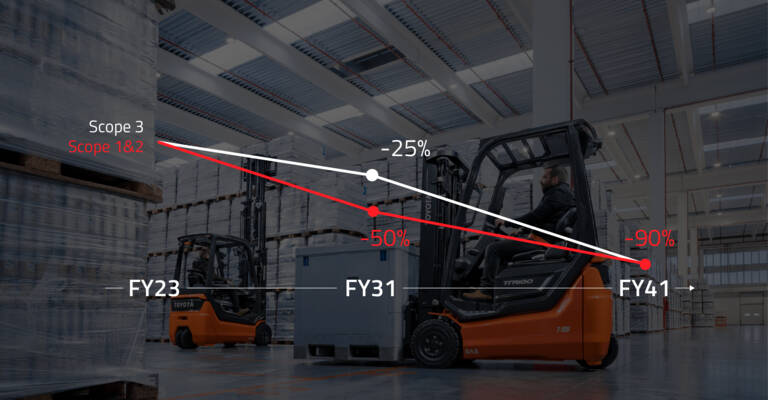
Our ambition is to achieve net zero greenhouse gas emissions across the entire value chain by FY2041, with science‑based targets approved by the Science Based Targets initiative (SBTi). This commitment is supported by continuous efforts in decarbonisation, resource efficiency, circular product design and transparency across Scope 1, 2 and 3 emissions.
By embedding sustainability into innovation, operations and collaboration with customers and partners, Toyota aims to go beyond compliance and actively shape more resilient, responsible and future‑proof logistics operations.

Logiconomi Connections for Sustainability
Through the Logiconomi Connections programme we identified innovative solution providers for typical sustainability challenges to support the industry.
-
- Cargo‑Planner - Software that helps optimise load planning and container utilisation to reduce transport movements, costs and CO₂ emissions.
- GRYN – Circular return and resale solution that supports recommerce flows, helping reduce waste and extend product lifecycles.
- KaroPack – Circular packaging solution enabling reusable and recyclable transport packaging to reduce single‑use waste in logistics operations.
- Pathfinder – Data‑driven planning platform that supports low‑carbon logistics decisions by modelling transport and energy scenarios.
- TGR Pallets – Reusable pallet solution that supports circular logistics by extending pallet lifecycles and reducing waste.